


DONNE DI NAPOLI
Giulia Franceschi

Born in Naples in 1870, Giulia is the daughter of the Tuscan sculptor and cabinetmaker Emilio Franceschi, who supported her growth until she became his precious collaborator in running her school-carving workshop. The field learning method combined with a completely new pedagogical approach will then be present in the characteristic commitment of Giulia Franceschi's life: the management of the nursery ship “Francesco Caracciolo”. In 1889 Giulia married the lawyer Teodoro Civita, taking his surname, and in 1891 Emilio, the couple's only child, was born. Gradually due to her husband's worsening health, Giulia Civita Franceschi sold her business in her father's workshop to her sister. From this closure, however, a new opportunity arises: to educate less fortunate young people about the autonomy and dignity of work. Following a project already started in other parts of Italy with the Nave Officina “Garaventa” in Genoa (active since 1883) which welcomes young people who have served prison sentences, and the Nave Asilo “Scilla” in Venice (active since 1906) as a fishing school for the orphans of Adriatic fishermen, the shuttle ship Caracciolo was inaugurated in 1913, in the presence of the Duke of Aosta Emanuele Filiberto. The sailing ship was donated by the Ministry of the Navy to the city of Naples to welcome orphans of seafarers and children at risk. To circumvent the constraint that a naval vessel must be manned, Commander David Levi-Morenos devises the solution of “delegating” Giulia Civita Franceschi to fill his role. Thus begins the “Civita system”, an innovative educational method aimed at the recovery and inclusion of minors at risk and in precarious health conditions. The pedagogical approach carried out by Franceschi is entirely new: you learn and work, you emerge from difficulty thanks to social solidarity and the dignity of work. From 1914 to 1928 Giulia Franceschi lived on the Caracciolo with her boys, sailing in the Gulf of Naples from Molo Beverello to Capo Miseno to cure their weaknesses thanks to the healthy air of the Campi Flegrei sea. The ship welcomes 750 children and young people by building a community where each child is known, respected and encouraged to develop their potential. In 1921 the SPEM (Fishermen and Marinaretti School) was established, to which in ’23 the State granted the management of the Fusaro and Mare Morto lakes, between Bacoli and Capo Miseno. In particular, at Fusaro, Franceschi wants to build a home for small fishermen and a school for the recovery of abandoned girls, but some private individuals are preventing her from doing any form of activity. As late as 1921, his work became a case study by a commission from Japan which, together with the Minister of Education and university professors, boarded the ship to learn about the educational system adopted. The following year, the Ministry of Education awarded her the gold medal for merit. The experience of “Montessori del mare”, as it was called by its admirers, ended abruptly in 1928 when Fascism removed it to include the Caracciolo project in the Opera Nazionale Balilla. Franceschi continued its activities with SPEM until 1933 when the fascist government took over the facilities made available by the Navy. Giulia then tried to found an elementary school and an agricultural course in the province of Caserta, in Santa Maria a Vico, on land owned by the Carlo van Den Heuvel nursery school, but these too were well requisitioned by the fascist regime. In the following years, Franceschi devoted herself to promoting her father's works and, above all, took part in the founding of the UDI women's movement, the Italian Women's Union. She engages in journalistic campaigns to focus the attention of society and politics on the issue of abandoned childhood. Giulia Franceschi died in Naples in 1957, and she remains a great example of the pedagogical method still studied today throughout the world.
Molo Beverello
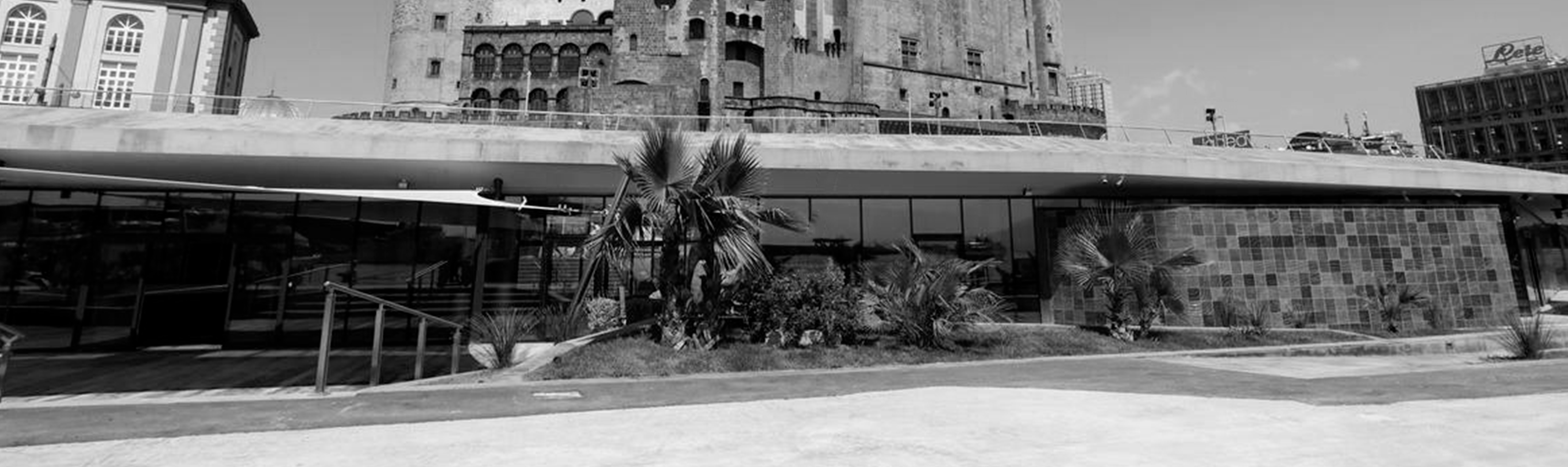
Molo Beverello is located in the area adjacent to Castel Nuovo, on the seafront, and is used as the main docking point for vessels sailing in the Gulf of Naples towards the islands of Ischia, Capri, and Procida, as well as Sorrento and the Amalfi Coast. Its name, Beverello, originates from a source of drinking water “bever ello” that was located in that area and gave drinks to passers-by. According to Benedetto Croce, the etymology of the term is also linked to the Turris Biberella, a control tower that no longer exists, connected to the Castel Nuovo area (also known as Maschio Angeino). Until the early ‘900 Molo Beverello remained a small landing place, used by King Ferdinand for fishing and swimming. The area was subsequently redeveloped and expanded with the addition of the Maritime Station, designed by architect Cesare Bazzani and completed in 1936. The Molo Beverello was also the docking point for the Caracciolo nursery ship led by Giulia Civita Franceschi, of which a photograph wearing naval garb is preserved and in the background the Angevin castle and the docks of the Molo. Today, the area is also used for docking cruise ships, and new buildings have been built integrated into the urban context to welcome travelers.